

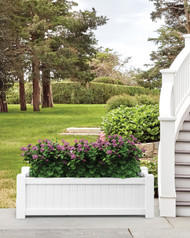
Large Outdoor Planters: A Guide to Choosing Premium Planter Boxes
A large outdoor planter is a freestanding container at least eighteen inches wide, used architecturally to anchor an entryway, frame a porch, or define a deck or patio. Premium planters are sized to the space, built to last in outdoor conditions, and finished in a shape and style that complements the home.
The right planter box does more than hold soil. It shapes the entryway, sets a visual tone for the home, and ages with the architecture rather than against it. Walpole Outdoors planters are handcrafted in solid cellular vinyl, with classic square, rectangular, and tapered designs built to hold their finish across freeze-thaw cycles, summer sun, and decades of outdoor exposure.
What Defines a Large Outdoor Planter?
A large outdoor planter is a freestanding container designed for substantial plantings, typically eighteen inches wide or more, with a height that matches its width for proportional balance. Large planters are used architecturally rather than horticulturally, meaning they shape the space first and hold plants second. They flank entryways in pairs, line walkways, anchor pergola corners, and create visual stops along long porches or terraces. Unlike standard pots, a large planter box is heavy enough and substantial enough to stay in place through weather and seasons, and its size accommodates topiaries, dwarf evergreens, or layered seasonal arrangements without looking crowded.
Choosing the Right Shape: Square, Rectangular, or Tapered
Planter shape is the first design decision, and it depends on where the planter will sit and what it needs to hold.
Square Planters
Square planters work best as standalone statement pieces or as a matched pair flanking an entryway. Their balanced proportions hold the eye and create symmetry. Walpole Outdoors square planters include the Square Rockport Planter, the Wimberley Square Planter, the larger Square Paneled Planter Box, the Standard Square Planter, and the Orangerie Planter with its signature sphere finials.
Rectangular Planters
Rectangular planters work along the length of a porch, deck rail, or walkway, and they hold mixed plantings more naturally than square boxes because the wider footprint allows multiple specimens to share root space. Walpole Outdoors rectangular planter options include the Rectangular Rockport Planter, the Wimberley Rectangular Planter, the Standard Rectangular Planter, and the Wickford Planters in larger architectural sizes.
Tapered Planters
Tapered planters narrow from top to bottom, which gives them visual lift and a more traditional, formal silhouette. The taper draws the eye upward and emphasizes the planting at the top. Walpole Outdoors offers the Tapered Rockport Planter and the Paneled Tapered Planter for this profile.
Choosing by Use Case: Where the Planter Will Go
Front Porch Planters
A front porch planter is sized to the porch first and the plant second. A pair of planters flanking the front door typically reads best when each planter is at least one-third the height of the door and roughly one-quarter to one-third its width. Smaller planters look lost on a substantial porch, and oversized planters block sight lines and crowd seating areas. Square and tapered shapes work especially well at front doors because they create symmetry without dominating the entryway.
Deck and Patio Planters
Deck and patio installations call for rectangular planters along railings or perimeter walls, where a longer footprint creates a continuous planted line. Freestanding deck planters can also define seating areas or screen one side of the deck from a neighboring view. For deck rail installations specifically, Walpole Outdoors window boxes offer a complementary low profile and are designed with two drainage holes and mounting brackets included.
Front Door and Entryway Planters
Entryway planters do more than hold plants. They signal the entrance, frame the door, and set the visual tone for the home. A symmetrical pair on either side of a front door is the classic choice. Tapered or square shapes work best here because they read as architectural elements rather than garden accessories. Color matters: white planters lift a darker entryway, black planters add weight to a light-painted facade, and natural finishes work with brick or stone.
Herb and Kitchen Garden Planters
A kitchen-garden planter sits close to a door or patio for easy access and is sized for shallow-rooted edibles rather than deep-rooted ornamentals. The Rockport Herb Planter is purpose-built for this use, with a wider, lower profile that suits herbs, lettuces, and compact vegetables.
Why Cellular Vinyl Planters Outlast Wood, Ceramic, and Concrete
The material a planter is built from determines how it ages. Outdoor planters face freeze-thaw cycles, summer sun, moisture against soil, and the weight of waterlogged plantings.
Wood planters look beautiful initially but rot from the inside out where soil meets the planter wall. Cedar lasts longer than pine but still requires sealing, staining, or replacement. Ceramic and terracotta planters crack in freeze and chip on impact. Concrete planters are exceptionally heavy, difficult to move, and prone to surface spalling over years of weather. Fiberglass planters fade and dull, and lower-quality versions become brittle in cold.
Walpole Outdoors planters are handcrafted in solid cellular vinyl, an advanced material that has the look and feel of natural wood but will not rot, split, warp, or fade. The material handles freeze-thaw cycles, holds paint and finish for years, and requires no annual maintenance. Walpole planters do not require plastic liners because the material itself is impervious to moisture. The result is a planter that looks like a premium wood box on day one and ten years later. Browse the full planter collection for complete sizing and finish specifications.
Color and Style: Matching Planters to the Home
Walpole Outdoors planters are available in white, black, and Iron Ore (a deep weathered gray). Color matters more than style for how the planter reads against the home.
- White planters work with shingle, brick, cedar, and most painted facades. They are the safest choice for traditional and coastal homes.
- Black planters add visual weight and modern contrast. They work especially well with light-painted homes, modern architecture, and gray or charcoal trim.
- Iron Ore is a contemporary neutral. It bridges traditional and modern aesthetics and pairs well with stone, gray siding, and natural wood.
Style decisions follow the home’s architecture. Paneled and tapered designs (Paneled Tapered, Standard) suit traditional and colonial homes. Wimberly suits contemporary homes.The Orangerie with its sphere finials reads formal. Rockport designs are classic and adaptable. Wickford planters work in larger architectural installations. The Inspiration Gallery shows planters installed in completed projects across a range of home styles.
How to Choose the Right Size Planter
Planter size depends on the space, the plant, and the visual goal. The table below summarizes the most common sizing guidance for premium residential installations.
|
Use Case |
Recommended Size |
Notes |
|
Door-flanking entryway pair |
At least one-third the height of the door, one-quarter to one-third its width |
Symmetry and proportion matter more than overall size |
|
Walkway lining a path |
18 to 30 inches tall |
Reads clearly without obstructing sight lines |
|
Deck or porch perimeter |
Wider than 3 feet for horizontal anchor, no narrower than 18 inches |
Smaller planters read as small accents |
|
Pergola corner anchor |
At least 24 inches square |
Balances the structure overhead |
|
Topiaries and dwarf evergreens |
At least 20 inches deep |
Root volume for overwintering |
Larger plantings, including topiaries, dwarf evergreens, and multi-season layered arrangements, all need a planter of at least twenty inches deep to give roots room to establish and overwinter.
Common Planter Box Questions
How big should a front porch planter be?
A front porch planter should be at least eighteen inches wide and one-third the height of the entry door. For most homes that translates to a planter between twenty-two and thirty inches tall. Larger porches and taller entryways scale up from there. The most common error is choosing planters that are too small, which makes the entryway look unfinished.
Do Walpole planters need a liner?
No. Walpole Outdoors planters are handcrafted in solid cellular vinyl, which is impervious to moisture and does not rot, warp, or stain. The material can be planted in directly without a plastic insert or sleeve, which means roots have access to the full interior volume of the planter.
Do planter boxes need drainage?
Yes. Outdoor planters need drainage holes to prevent waterlogged soil and root rot. Walpole Outdoors window boxes ship with drainage holes already in place. Larger planters typically have drainage built into the base or are designed for the homeowner to fill the bottom with gravel or a drainage layer before planting.
How long does a cellular vinyl planter last?
Solid cellular vinyl planters can last many years with minimal maintenance, holding their color and shape across freeze-thaw cycles and seasonal moisture exposure. The material does not rot, split, or warp, and the finish does not require annual sealing or staining. Walpole Outdoors planters are engineered to resist warping, moisture, and sun damage, retaining their carpenter-finish and color for decades, and they are backed by a 25-year limited product warranty.
How much do large outdoor planters cost?
Walpole Outdoors planter pricing spans from the smaller Square Rockport up through the larger architectural Wickford Planters, with mid-range options including the Wimberley, Rectangular Rockport, and Paneled Tapered planters. Custom-sized planters are also available and quoted individually based on dimensions and finish. Current pricing for each design is shown on the product pages.
Planning planters as part of a larger outdoor design? See the Walpole Outdoors guide to customized enclosures for unique spaces for how planters, lattice, and screens come together within courtyard walls, garden enclosures, and pergola spaces.
Choose Your Walpole Outdoors Planters
Whether the project calls for a matched pair of square planters at the front door, a row of rectangular boxes along a deck, or a planter sized to a specific architectural condition, Walpole Outdoors has been crafting luxury planters and outdoor architectural elements since 1933, with 93 years of craftsmanship and nationwide delivery. Browse the planter collection to see complete sizing, finish, and pricing for each design.