

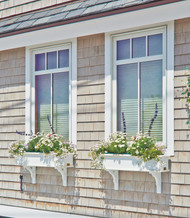
How to Install Window Boxes: A Walpole Outdoors Guide
To install a window box, select a box sized to span the window width, mount two or three brackets into the wall framing or masonry behind the siding using fasteners appropriate to the wall material, level each bracket and seal the fastener holes against water intrusion, then set the box onto the brackets and confirm drainage before planting. The full installation takes about an hour per window for most siding types.
What to Look For in a Window Box
Three things matter most when choosing a window box: the material, the style, and the brackets.
Window Box Material
Wood window boxes are the traditional choice and offer a classic look, but they require ongoing maintenance to hold up to weather and the constant moisture from soil and watering. Periodic sealing or painting is needed to extend the life of the box, and even with maintenance, the box will eventually need to be replaced.
PVC and vinyl window boxes are lighter and lower maintenance. Cellular vinyl, sometimes called solid cellular vinyl, is a denser variant designed for exterior trim and architectural applications. It holds paint, resists warping, and does not rot.
Walpole Outdoors window boxes are crafted in solid cellular vinyl, an advanced material that holds paint, will not rot, split, or warp, and requires no scraping or repainting over the life of the box. Because the material itself does not absorb water, a separate plastic or metal liner is not required.
Brackets and Mounting Hardware
The brackets are the most important hardware decision in a window box installation. Brackets transfer the weight of the box, soil, water, and plants into the wall framing or masonry behind the siding. A planted window box weighs significantly more than the empty box, especially when soil is saturated after watering or rain. The curved decorative brackets included with Walpole Outdoors window boxes are designed to handle the full loaded weight. The number of brackets scales with the length of the box: most use two brackets, while the widest boxes (60 inches and 72 inches) use three for proper support.
Window Box Sizing and Placement
Window Box Length
A window box should generally span the full width of the window or extend a few inches beyond the window casing on each side. A box that stops short of the window edges looks under-scaled and tends to disappear visually. Walpole Outdoors window boxes are available in widths from 24 inches to 72 inches to fit most standard window sizes, with custom sizing available for unconventional window designs.
Window Box Height and Placement
Most window boxes mount one to two inches below the window sill, leaving a small visual gap that lets the box read as a separate architectural element. Mounting too high crowds the window; mounting too low orphans the box from the window it is meant to accent. For out-swinging casement windows, the box needs to mount low enough to clear the window when it opens, usually six to eight inches below the sill. For double-hung and sliding windows, a smaller gap of one to two inches is typical.
Tools and Materials for Installation
Most window box installations require the same set of tools regardless of siding type. Some siding types require additional hardware, covered in the siding-specific section below.
- Stud finder, for locating wall framing behind the siding
- Drill with appropriate bits for the wall material
- Level (a two-foot level works well for most window box widths)
- Tape measure and pencil
- Mounting screws or lag bolts appropriate to the wall material (provided with most Walpole Outdoors brackets, but verify before installation)
- Exterior-grade caulk or sealant for the fastener holes on porous or painted surfaces
- Safety glasses and gloves
How to Install a Window Box: Step-by-Step
The installation process is the same for most window box and siding combinations, with adjustments at the fastening step depending on whether the wall is framed wood, masonry, or another material.
Step 1: Position the Window Box and Mark the Bracket Locations
Hold the window box in position under the window, centered on the window width and at the desired height below the sill. Mark the outer edges of the box on the wall lightly in pencil. Then set the box down and position one bracket where it will sit, generally about two to four inches in from the end of the box. Use a stud finder to confirm whether the bracket location aligns with wall framing behind the siding. If it does not, shift the bracket toward the nearest stud. The brackets must transfer load into the wall framing, not into the siding alone.
Step 2: Confirm Level and Mark the Pilot Holes
Hold the first bracket against the wall at the marked position. Set a level on top of the bracket arm where the window box will rest. Adjust the bracket up or down until level. Mark the screw holes through the bracket onto the wall. Repeat the process on the opposite side of the window, using the level to confirm both brackets sit at the exact same height. For window boxes longer than 60 inches, a third center bracket is required, marked using the same method.
Step 3: Drill Pilot Holes and Mount the Brackets
Drill pilot holes at each marked location, using a bit sized for the fasteners provided with the brackets. The bit size depends on the wall material and the type of fastener. Once the pilot holes are drilled, position each bracket and drive the fasteners until the bracket sits flush against the wall and does not move when pressure is applied. Apply exterior-grade caulk around the fastener heads on porous or painted surfaces to seal out water.
Step 4: Set the Window Box on the Brackets
Lift the window box onto the brackets and confirm it sits level. The decorative trim ring along the top of the box doubles as a locking element on many Walpole Outdoors models, fitting snugly into the curved bracket arms. Some boxes secure to the brackets with hidden fasteners driven up through the bracket arm into the bottom of the box; others rest in the brackets without additional fastening. Check the product instructions for the specific box being installed.
Step 5: Confirm Drainage and Plant
Before adding soil and plants, confirm the drainage holes in the bottom of the window box are clear. Walpole Outdoors window boxes come with two drainage holes pre-cut into the bottom of the box. Add soil and plants once drainage is confirmed. Water the box and check that water drains freely from the drainage holes and does not pool inside.
Installing Window Boxes on Different Siding Types
The fastening method depends on the wall material. The principles stay the same: locate the framing or solid backing behind the siding, mount into that backing, and seal the fastener holes against water intrusion. The table below summarizes the differences.
|
Siding Type |
Fastener and Bit |
Key Installation Note |
|
Vinyl |
Wood screws into framing, masonry bit not required |
Drill through siding into stud; add vinyl mounting block for a flat backing |
|
Brick |
Masonry anchors with a masonry bit |
Drill into brick face, not mortar joints; mortar is softer and less secure |
|
Wood Clapboard / Shingle |
Wood screws or lag bolts |
Most straightforward installation; siding holds fasteners with proper stud alignment |
|
Stucco |
Stucco or expansion anchors with a masonry bit |
Drill slowly at low speed to prevent cracking; seal anchor holes against hairline spread |
|
Aluminum |
Wood screws into framing with a backing block |
Use a backing block to prevent denting when the bracket is tightened |
|
Fiber Cement |
Wood screws with pilot holes drilled with a masonry bit |
Pilot holes are required to prevent the siding from cracking under fastener load |
In every case, brackets should align with wall framing or solid masonry behind the siding. Mounting into siding alone will not support the loaded weight of a planted window box.
Vinyl Siding
Vinyl siding cannot support the weight of a planted window box on its own. The brackets must fasten through the siding into the wall sheathing and framing behind it. Locate the wall studs with a stud finder, drill through the vinyl siding into the framing, and seal around the fastener with exterior-grade caulk to prevent water from migrating behind the siding. A vinyl siding mounting block or trim ring can be added behind each bracket to provide a flat, stable surface and a cleaner finish where the bracket meets the irregular vinyl profile.
Brick
Brick walls require masonry anchors rather than wood screws. Mark the pilot holes through the bracket, drill into the brick face with a masonry bit, insert appropriately sized masonry anchors, and drive the mounting screws into the anchors. Avoid drilling into the mortar joints between bricks where possible, as the mortar is softer than the brick and provides a less secure anchor. Exterior-grade caulk should be applied around the anchor holes to seal out water.
Wood Siding and Shingle Siding
Wood clapboard, shingle, and shake siding are the most straightforward to install on. The siding itself is generally solid enough to fasten into directly, though the bracket should still be positioned over a wall stud for full load support. Drill pilot holes, drive the fasteners, and seal the fastener heads with exterior-grade caulk or paint touch-up.
Stucco
Stucco walls require careful drilling to avoid cracking the surface. Mark the pilot holes through the bracket, then drill slowly with a masonry bit at low speed. Stucco anchors or appropriately sized expansion anchors should be used to grip the substrate behind the stucco. Apply exterior-grade caulk around the anchor holes to seal out water and prevent hairline cracks from spreading.
Aluminum and Fiber Cement Siding
Aluminum siding is fastened similarly to vinyl: through the siding into the wall framing behind it. Aluminum is more prone to denting than vinyl, so a backing block can prevent the siding from deforming when the bracket is tightened. Fiber cement siding holds fasteners well but requires pilot holes drilled with a masonry bit before driving screws to avoid cracking the siding. The bracket should still align with the wall framing behind the fiber cement for full load support.
Drainage and Liners: Why Walpole Outdoors Window Boxes Do Not Need a Liner
Many homeowners assume a window box needs a separate plastic or metal liner inside it. Whether a liner is necessary depends on the material the box is made of. Wood window boxes require a liner because untreated wood absorbs water and rots, and the liner becomes a maintenance item that can crack, warp, or develop hidden drainage issues.
Walpole Outdoors window boxes do not require a liner because the cellular vinyl construction is itself impervious to water. The box can be planted directly with soil. The two drainage holes pre-cut into the bottom of every Walpole Outdoors window box let water exit freely after watering or rain. The result is fewer components, fewer maintenance steps, and a longer service life.
Whether or not a liner is used, the drainage holes themselves are critical. A window box without drainage will hold water at the root level and drown most plants within a season. If a window box does not have pre-cut drainage holes, they should be drilled into the bottom before planting.
Window Box Maintenance
Cellular vinyl boxes require no painting, sealing, or staining. The boxes can be cleaned with mild soap and water as needed. The brackets should be inspected once a year, after a winter or storm season, to confirm fasteners are still tight and the bracket has not shifted in the wall. For the plants, window boxes dry out faster than in-ground plantings because the soil volume is small and the box is exposed to sun and wind on multiple sides. Most window boxes need watering every day or every other day in summer.
Common Window Box Installation Questions
Can you install a window box without drilling?
In most cases, no. Window boxes loaded with soil, plants, and water are heavy enough that they require fasteners driven into the wall framing or masonry to stay secure. Some no-drill clip systems exist for vinyl siding, but they rely on the siding itself to hold the weight and are generally not recommended for anything larger than a small herb-sized box. For full-size window boxes on any siding type, drilling and fastening into the structural wall behind the siding is the only reliable method.
How do you secure a window box?
A window box is secured by mounting two or three brackets into the wall framing or masonry behind the siding, then setting the box onto the brackets. The brackets carry the weight; the box itself simply rests on them. Some window boxes use hidden fasteners to lock the box to the brackets; others rely on the fit between the bracket arms and the box. Always confirm the brackets are fastened into solid backing, not into the siding alone.
Should window boxes have drainage holes?
Yes. Without drainage, water collects at the root level after watering or rain, and most plants will not survive long in saturated soil. Walpole Outdoors window boxes come with two drainage holes pre-cut into the bottom of every box. If a window box does not have pre-cut drainage holes, they should be drilled into the bottom before the box is planted.
How big should a window box be?
The window box should generally match the width of the window or extend a few inches past the window casing on each side. A box that stops short of the window edges looks under-scaled. The depth and height of the box are determined by the plants the homeowner wants to grow: most flowering annuals do well in a box six to eight inches deep, while larger plants and small shrubs need a deeper box. Walpole Outdoors window boxes range from 7.5 inches high in the bullnose style to 10 inches high in the estate style.
Choose Your Walpole Outdoors Window Box
Walpole Outdoors has been crafting high-end window boxes and outdoor architectural elements since 1933, with 93 years of craftsmanship and nationwide delivery. The collection includes the Bullnose Window Box, the Brentwood Window Box Kit, the Estate Window Box, the Paneled Window Box, and the Rockport Window Box Kit, available in widths from 24 inches to 72 inches with custom sizing available for unconventional windows. Browse the window box collection to find the right box for the home.