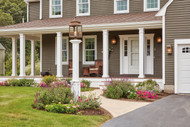
A Guide to Choosing the Right Fixtures for Your Home
Exceptional design doesn't stop at the front door. The fixtures you choose for your home's exterior set a tone before anyone steps inside. Walpole Outdoors approaches outdoor lighting as permanent installations rather than replaceable products. Northern white cedar that silvers with age. Hand-finished brass that darkens to bronze. Granite bases that outlast the mortgage. These are fixtures crafted to last decades, matched to your home's proportions, and built to age with grace.
This guide will show you how to choose outdoor lighting that looks and feels like it belongs in your home.
Why It Matters
Fine lighting enhances what exists. Adds depth. Creates order.
Good outdoor lighting is rarely noticed at first glance. You feel it working. Paths are clear. Entrances are easy to find. The house reads as complete after sunset. Your guests will arrive without hesitation. Your family will move through the yard with confidence. Pull into the driveway after a long trip, and the house will welcome you home.
Our lighting decisions begin with how the property is actually used: where guests arrive, how families move between spaces, which features deserve attention without overwhelming the scene. We treat lighting as an extension of the structure itself, with the same attention to scale, material, and longevity you'd expect from any permanent installation. The goal is clarity without harshness, presence without glare.
The Core Types of Outdoor Lighting
Post lights guide movement through open areas. Wall lighting frames doors and exterior walls. Pathway lighting improves visibility at ground level. Landscape lighting adds depth by highlighting specific features. Used in moderation, these fixtures create balance. Understanding their roles helps you build a cohesive system where scale, material, and intent work together, not against each other.
Most people use too many fixture types. Three or four is usually the sweet spot. More than that, and the exterior starts to feel busy.
Post Lights
Post lights establish rhythm. Make them feel original.
Placed at consistent intervals, post lights guide movement without demanding attention. Our collection features lantern posts crafted from natural granite and solid cellular vinyl (CPVC). Granite provides a rugged, permanent presence that weathers naturally over time. Our solid cellular vinyl posts offer the classic proportions of traditional posts while resisting rot, splitting, and the constant repainting required by wood. These materials are chosen not just for how they look at installation, but for their ability to maintain strength and character through years of exposure.
Scale matters. A post light should feel proportionate to its surroundings during the day and quietly functional at night. Fixtures that are too tall or overly ornate disrupt the landscape. We help homeowners choose heights, bases, and lantern styles that complement the home’s façade so the fixture looks as if it were there from the very beginning.
Even spacing creates clarity. For walkways, 8 to 10 feet between posts works well. For driveways, 10 to 15 feet. Most people space post lights too close together, they’re afraid of darkness. But darkness is what makes light meaningful. When choosing post lights, consider light output measured in lumens: 50 to 200 for gardens and pathways, and 200 to 600 for driveways and entryways where visibility is critical.
At the Entrance
First impression. Last light on. Wall lighting frames the welcome.
Every night, you walk past your entry lighting. You've stopped noticing it. That's the problem. Wall lighting should make the entry feel deliberate, not forgettable. The fixtures in our collection feature finishes that develop a natural patina year by year. These aren't surface treatments. The finish deepens with time, settling into something warmer and more grounded. Over years, it gains character. Over decades, it became part of the architecture.
Scale is everything. A wall light should correspond to the door, not float above it or crowd beside it. When the scale is wrong, the entry feels disconnected. When it's right, the fixture looks like it's been there from the beginning. We help you choose mounting height, width, and placement so the light reads as original to the house. Whether used singly or in pairs, wall lighting should feel anchored and permanent, not decorative or added later.
On the Ground
Pathway lighting illuminates what's ahead. Keep it low. Keep it focused.
Its job is to make the ground visible, not to brighten the entire space. Even spacing helps guide movement naturally, especially near elevation changes where missteps are more likely. When light is directed downward and kept consistent, paths feel safer without becoming visually busy or creating glare.
Walpole pathway lights are scaled for subtlety, not intensity. Just enough light to see the next step, not the entire yard. We plan pathway lighting with attention to rhythm, turn points, and how people actually travel through the property. Good pathway lighting is most noticeable when it's missing. You'll realize its value the first time you walk the garden after sunset without hesitation. Your phone stays in your pocket: That's the test.
Planning Your System
Start with what you use most. Entry first. Paths second. Accents last.
This order creates a cohesive lighting plan. Strategic placement illuminates key features while improving both curb appeal and functionality. Consider how lighting will work with your existing outdoor structures. Bespoke pergolas, garden arbors, and custom fencing can all be transformed with proper illumination. Motion sensor lights add security by activating when someone approaches. Floodlights and spotlights create well-lit exteriors that discourage unwanted visitors.
Your entry should feel welcoming, not interrogative. Your driveway should guide, not glare. Your landscape should reveal itself gradually, not all at once. Security and restraint coexist when the plan is deliberate. The goal is confidence, not surveillance.
Landscape Accents
Landscape lighting works best when it's selective. One thing. Maybe two.
A mature tree. A stone wall. A garden path. This approach showcases unique features without flattening the scene or eliminating the natural shadows that create depth after dark. A few well-placed lights add dimension. Too many compete with one another. We favor lighting that disappears during the day and feels natural at night, supporting the landscape instead of dominating it.
Modern LED technology uses a fraction of the energy of traditional bulbs while delivering brighter, longer-lasting illumination with minimal maintenance. The goal is enhancement, not transformation. Your landscape should feel like itself at night, just more carefully revealed. The tree you pass every day will suddenly have structure. The wall you take for granted will cast shadows that change with the seasons. With great accent lighting, every season has the potential to reveal textures you never noticed.
Matching Your Home
Outdoor lighting should respect the character of the building. Not trends. Structure.
Traditional homes call for fixtures that emphasize proportion and material quality over ornamentation. Cleaner-lined homes benefit from lighting that mirrors simplicity and precision, with fixtures that echo geometric clarity. Choose lighting that aligns with the structure itself. It results in an exterior that ages well and feels authentic.
In five years, trendy fixtures will look dated. In ten, they'll need replacing. In twenty, you'll wish you'd chosen better. Our lighting collection features designs ranging from classic to contemporary, with styles and finishes to complement your home's aesthetic. We recommend fixtures by starting with the structure first and selecting forms that belong. What works on a 1920s Colonial has no place on a modern farmhouse. Your home tells you what it needs.
See Walpole's lighting collection
Placement Principles
Placement matters as much as the fixture. Spacing. Height. Alignment.
Consistent spacing, appropriate mounting heights, and alignment with structural features all contribute to work that looks considered and complete. Lighting should support how people move through a space, highlighting transitions and edges. We plan placement from the perspective of arrival: how the home reads from the street, from the walk, from the front door at night. The experience should unfold logically as visitors approach.
Walk your property at dusk. Notice where you slow down. Notice where you squint. Notice where you'd feel safer with more light. Those moments tell you where fixtures belong. Planning before installation separates lighting that works from lighting that disappoints. You'll see it every time you pull into your driveway.
Materials That Last
Outdoor lighting fixtures face weather year-round. Choose materials that age with grace.
Solid brass and copper are naturally corrosion-resistant and develop rich patinas that enhance their character over time. These are not commodity metals. They are specification-grade materials selected for structural integrity and longevity. The brass will darken. The copper will warm. Both will look better in fifteen years than they do today.
Solid cellular vinyl offers durability while requiring almost no maintenance beyond occasional cleaning. We select materials that meet the same standards used across our exterior products. Whether you choose the natural weight of granite or the clean precision of CPVC, these materials are designed to age gracefully with your home. Over time, finishes deepen and gain character. We firmly believe your entry light should outlast your mortgage.
Browse outdoor lighting fixtures
Installation and Care
Before installing, think through access, wiring, and maintenance. Design for care, not around it.
Thoughtful care preserves performance and appearance without demanding excessive time or expertise. Periodic cleaning and occasional checks are all that's required. We consider maintenance at the design stage, favoring fixtures with accessible housings and durable hardware so care remains straightforward. LED technology reduces maintenance needs by lasting significantly longer than traditional bulbs while maintaining consistent light quality throughout their lifespan.
Well-designed lighting requires minimal attention: cleaning when needed, checking connections before winter, and replacing bulbs when they fail. If you're replacing bulbs every season, something is wrong.
Where To Begin
If you're unsure where to start, begin at the entry. Then paths. Then accents.
Our design consultants help translate priorities into a phased plan, so the result feels cohesive from the first fixture to the last. Each addition builds on what came before. Start with one fixture. See how it changes the approach. Then decide what's next. You'll know when the plan is complete because the house will feel finished after dark, not decorated, finished.
Find the right outdoor lighting
FAQ/What We Hear Most
What type of outdoor lighting is best for safety?
Pathway lighting and wall-mounted fixtures near entryways. Even downward-directed light illuminates ground-level hazards like steps and elevation changes. Motion sensor lights add security by activating when someone approaches.
How do I determine the right brightness?
Brightness depends on purpose. Pathway and garden lights work well with 50-200 lumens for a soft glow. Entryways and driveways need 200-600 lumens for clear visibility. Too much creates glare and diminishes ambiance.
What materials last longest?
Solid brass, copper, and high-grade cellular vinyl. Brass and copper are corrosion-resistant and develop attractive patinas. Look for wet-rated fixtures with lifetime guarantees on construction.
How far apart should post lights be spaced?
8-10 feet for walkways, 10-15 feet for driveways. Even spacing creates rhythm without overlapping light pools. Adjust based on your fixture's lumen output.
Are LED lights worth it?
Yes. They use a fraction of the energy while lasting significantly longer. They reduce costs, require fewer replacements, and maintain consistent quality. The upfront cost pays for itself.
How many fixture types should I use?
Three to four: wall lighting at entries, post lights along paths, pathway lighting at ground level, and selective landscape accents. More creates visual clutter.
What finish should I choose?
Complement your home's existing hardware and details. Hand-applied living finishes patina naturally. Avoid highly polished finishes in coastal or humid climates where they require more maintenance.
Can I install these myself?
Simple solar or low-voltage pathway lights, yes. Line-voltage fixtures (120V) require licensed electrical work for safety and code compliance.
How do I light a long driveway?
Post lights on one or both sides, depending on width. Space consistently at 10-15 feet with higher lumen output. Consider bollard-style lights that sit lower to avoid glare.
What's the difference between landscape and outdoor lighting?
Outdoor lighting covers all exterior fixtures. Landscape lighting specifically highlights plants, trees, features, or hardscape. Both work together for a complete plan.